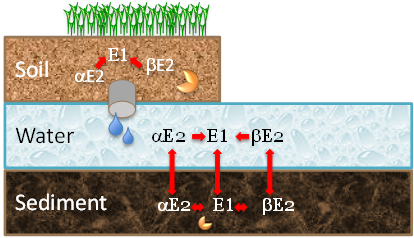
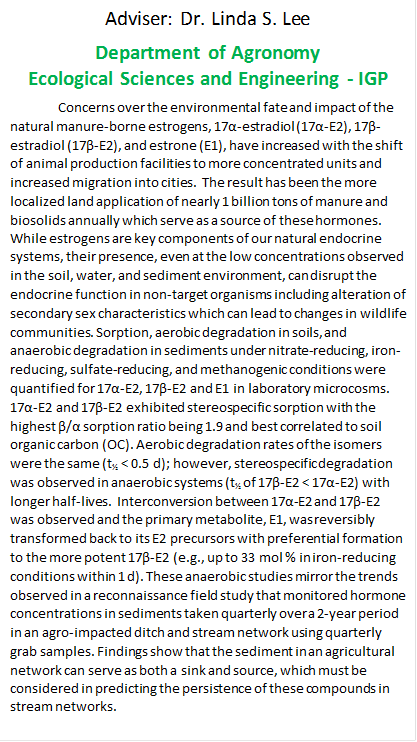
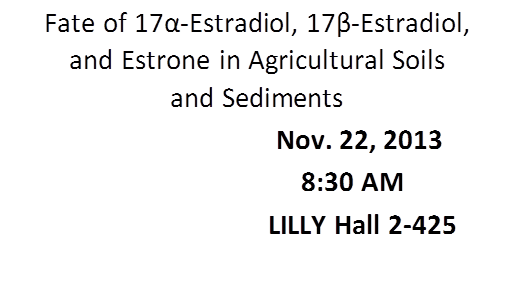
[Adviser: Dr. Linda S. Lee Department of Agronomy Ecological Sciences and Engineering - IGP Concerns over the environmental fate and impact of the natural manure-borne estrogens, 17α-estradiol (17α-E2), 17β-estradiol (17β-E2), and estrone (E1), have increased with the shift of animal production facilities to more concentrated units and increased migration into cities. The result has been the more localized land application of nearly 1 billion tons of manure and biosolids annually which serve as a source of these hormones. While estrogens are key components of our natural endocrine systems, their presence, even at the low concentrations observed in the soil, water, and sediment environment, can disrupt the endocrine function in non-target organisms including alteration of secondary sex characteristics which can lead to changes in wildlife communities. Sorption, aerobic degradation in soils, and anaerobic degradation in sediments under nitrate-reducing, iron-reducing, sulfate-reducing, and methanogenic conditions were quantified for 17α-E2, 17β-E2 and E1 in laboratory microcosms. 17α-E2 and 17β-E2 exhibited stereospecific sorption with the highest β/α sorption ratio being 1.9 and best correlated to soil organic carbon (OC). Aerobic degradation rates of the isomers were the same (t½ < 0.5 d); however, stereospecific degradation was observed in anaerobic systems (t½ of 17β-E2 < 17α-E2) with longer half-lives. Interconversion between 17α-E2 and 17β-E2 was observed and the primary metabolite, E1, was reversibly transformed back to its E2 precursors with preferential formation to the more potent 17β-E2 (e.g., up to 33 mol % in iron-reducing conditions within 1 d). These anaerobic studies mirror the trends observed in a reconnaissance field study that monitored hormone concentrations in sediments taken quarterly over a 2-year period in an agro-impacted ditch and stream network using quarterly grab samples. Findings show that the sediment in an agricultural network can serve as both a sink and source, which must be considered in predicting the persistence of these compounds in stream networks.][logo_trans.gif][Michael Mashtare An avid Boston Red Sox Fan, Michael was born in Alaska and lived in 9 states before landing at Purdue where he received his BS in NRES in 2009 and moved right into a PhD program through the ESE-IGP. During his graduate studies, Michael has served as a teaching assistant for Environmental Soil Chemistry, Introductory Soils, and Soil Fertility as well as an ESE P2P mentor, NRES Senior capstone mentor, and most recently as a co-instructor of the ESE Colloquium. He has received numerous awards including the 2013 ASA Environ. Quality Outstanding Grad. Student, USDA AFRI NIFA Postdoctoral Fellowship (starts 2014), 2013 ESE Summit People's Choice Award, 2013 Committee of Education of Teaching Assistants (CETA) Teaching Award, 2013 Outstanding Grad. Teaching Award, 2013 Joe L. White Grad. Student Award in Soil Chemistry and Mineralogy, 2 NSF GRFP honorable mentions, Sigma Xi Grant-in-Aid of Research, and several travel grant awards.][Fate of 17α-Estradiol, 17β-Estradiol, and Estrone in Agricultural Soils and Sediments Nov. 22, 2013 8:30 AM LILLY Hall 2-425][cid:image019.jpg@01CEE42A.09DCAEA0][cid:image017.png@01CEE429.5FC1EDE0]