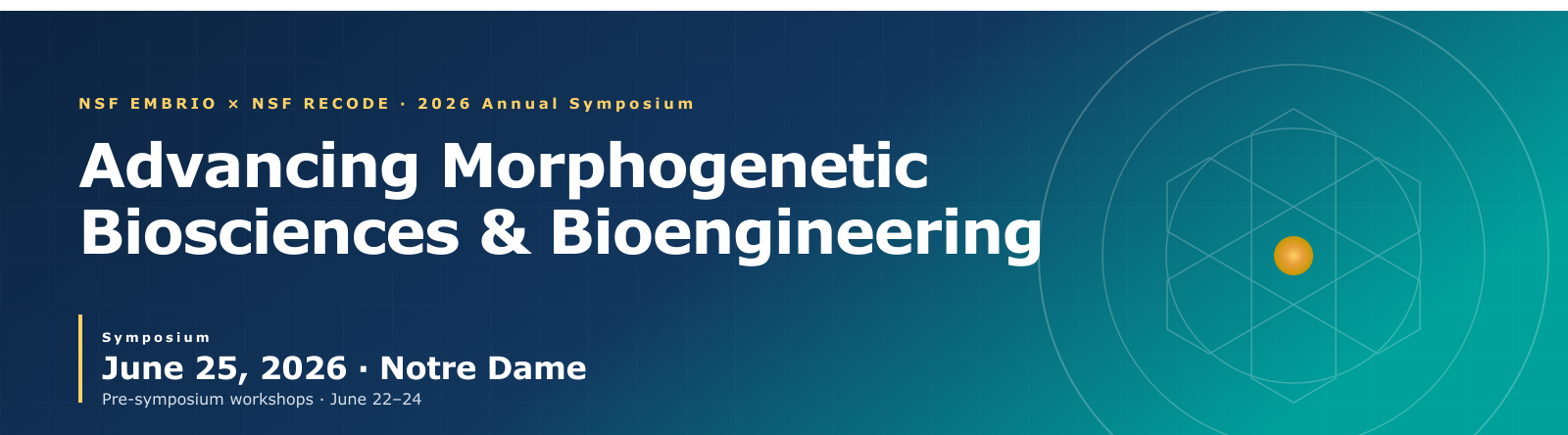
[cid:7fc5fa9c-35d7-419b-94d4-7f8ae15e45ec] Dear EMBRIOnic People, 👉REGISTER NOW: EMBRIO SUMMER WORKSHOPS AND RESEARCH SYMPOSIUM – JUNE 22-25 [cid:6096ab05-cc35-442f-9985-b5a2280ae2c4] Early registration is open<https://nam04.safelinks.protection.outlook.com/?url=https%3A%2F%2Fcvent.me%2FY0naAE&data=05%7C02%7Cembrio-list%40ecn.purdue.edu%7C23bb61f754614f0a249f08deaf88aca9%7C4130bd397c53419cb1e58758d6d63f21%7C1%7C0%7C639141198708533536%7CUnknown%7CTWFpbGZsb3d8eyJFbXB0eU1hcGkiOnRydWUsIlYiOiIwLjAuMDAwMCIsIlAiOiJXaW4zMiIsIkFOIjoiTWFpbCIsIldUIjoyfQ%3D%3D%7C0%7C%7C%7C&sdata=De9il9tqWti4L00xpFjlfZT5fN%2B3AeTV1Ayw4JaKdCM%3D&reserved=0> through May 18th for our joint summer school workshops and symposium (event website<https://www.purdue.edu/research/embrio/research/jointsymposium.php>). This will be an opportunity to increase your skills in employing AI in research, increase your image analysis tool kit, and team up to create new methods and tools, as well as engage with a network of leading scientists and engineers with room for all to present their research. We are working on finalizing speakers, keynotes, panel and poster sessions for the symposium in the next few days and will have a complete schedule to share soon. Workshop details are available at the website. There will be coordinated travel option between Purdue and Notre Dame. *Please note that we are asking EMBRIO attendees to chip in a $15 registration fee to cover materials (incl. event T-shirt). If you have any issues or questions regarding the registration process, please contact Kaylee Wolf at Notre Dame (kwolf5@nd.edu<mailto:kwolf5@nd.edu> ). 👀 EMBRIO RESEARCH UPDATES – MAY 18TH: ZOOM<https://nam04.safelinks.protection.outlook.com/?url=https%3A%2F%2Fpurdue-edu.zoom.us%2Fj%2F92296822713%3Fpwd%3Dm8tGuX9zXUL2MnYguV8KlCa9w0Tj4j.1%26from%3Daddon&data=05%7C02%7Cembrio-list%40ecn.purdue.edu%7C23bb61f754614f0a249f08deaf88aca9%7C4130bd397c53419cb1e58758d6d63f21%7C1%7C0%7C639141198708559734%7CUnknown%7CTWFpbGZsb3d8eyJFbXB0eU1hcGkiOnRydWUsIlYiOiIwLjAuMDAwMCIsIlAiOiJXaW4zMiIsIkFOIjoiTWFpbCIsIldUIjoyfQ%3D%3D%7C0%7C%7C%7C&sdata=2GTpukz7vCTtP9PzMzkXRntraNQoyOdJRvgtOBCHYIE%3D&reserved=0> Plan to join us next Monday at 3PM EDT when we will feature research updates with a presentation from the Gardner Lab in Thrust 4, and a presentation from collaborative research in Thrust 1 from the Kinzer-Ursem + Evans Labs. ‼️EMBRIO PAPER MODELING EVL CHANGES AND EXTERNAL FORCES DURING ZEBRAFISH EPIBOLY Congratulations to Sharon Minsuk, lead author, and all co-authors on the recent npj Systems Biology and Applications paper featuring the Modeling epithelial deformation and cell rearrangement in response to external forces during Zebrafish epiboly<https://nam04.safelinks.protection.outlook.com/?url=https%3A%2F%2Fwww.nature.com%2Farticles%2Fs41540-026-00708-0&data=05%7C02%7Cembrio-list%40ecn.purdue.edu%7C23bb61f754614f0a249f08deaf88aca9%7C4130bd397c53419cb1e58758d6d63f21%7C1%7C0%7C639141198708579144%7CUnknown%7CTWFpbGZsb3d8eyJFbXB0eU1hcGkiOnRydWUsIlYiOiIwLjAuMDAwMCIsIlAiOiJXaW4zMiIsIkFOIjoiTWFpbCIsIldUIjoyfQ%3D%3D%7C0%7C%7C%7C&sdata=5lupU0vLv1L7zoVaQPz9Qzz4gV2%2Fro7Y8QJSIGYoWlg%3D&reserved=0>. EMBRIO labs involved include Glazier, Mullins, and Umulis, along with T.J. Sego (now at U of FL). Collaborating with the team, Sharon constructed an agent-based model of the enveloping layer (EVL) during epiboly and its response to exogenous forces using a center-based simulation framework (Tissue Forge, developed by the Glazier lab). Their model captures the large viscoelastoplastic deformation of the EVL by cell rearrangement, and accommodates the required cell neighbor exchanges without losing mechanical integration. This is a major accomplishment. Learn more at the online article<https://nam04.safelinks.protection.outlook.com/?url=https%3A%2F%2Fwww.nature.com%2Farticles%2Fs41540-026-00708-0&data=05%7C02%7Cembrio-list%40ecn.purdue.edu%7C23bb61f754614f0a249f08deaf88aca9%7C4130bd397c53419cb1e58758d6d63f21%7C1%7C0%7C639141198708599341%7CUnknown%7CTWFpbGZsb3d8eyJFbXB0eU1hcGkiOnRydWUsIlYiOiIwLjAuMDAwMCIsIlAiOiJXaW4zMiIsIkFOIjoiTWFpbCIsIldUIjoyfQ%3D%3D%7C0%7C%7C%7C&sdata=a5c66tLbBmyP%2BZl95MArxh%2FjyNcahwKYuVU7mWMj6TI%3D&reserved=0>. [Fig. 11: Rate of EVL edge straightening correlates negatively with the strength of the bond angle constraint as applied to leading edge bond transformations.] Fig. 11: Rate of EVL edge straightening correlates negatively with the strength of the bond angle constraint as applied to leading edge bond transformations. Brent T. Ladd, Senior Research Program Manager, EMBRIO Institute<https://www.purdue.edu/research/embrio/> Weldon School of Biomedical Engineering, Purdue University Office: Hall for Discovery Learning and Research, Ste. 203 207 S. Martin Jischke Drive West Lafayette, IN 47907 laddb@purdue.edu