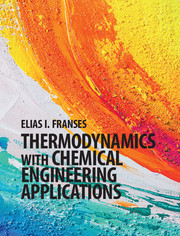
Dear Colleagues, Pl read below re Elias’ forthcoming book, with the Cambridge Univ Press – wonderful to see another UG textbook coming from our School. Congratulations, Elias! Arvind <http://www.cambridge.org/us/academic/subjects/engineering/chemical-engineering/thermodynamics-chemical-engineering-applications> [Thermodynamics with Chemical Engineering Applications] Thermodynamics with Chemical Engineering Applications Part of Cambridge Series in Chemical Engineering<http://www.cambridge.org/us/academic/subjects/engineering/chemical-engineering/series/cambridge-series-chemical-engineering> * Author: Elias I. Franses<http://www.cambridge.org/us/academic/subjects/engineering/chemical-engineering/thermodynamics-chemical-engineering-applications#bookPeople> * Publication planned for: August 2014 * availability: Not yet published - available from August 2014 * format: Hardback * isbn: 9781107069756 <http://www.cambridge.org/us/academic/subjects/engineering/chemical-engineering/thermodynamics-chemical-engineering-applications> $110.00 (X) Hardback Master the principles of thermodynamics with this comprehensive undergraduate textbook, carefully developed to provide students of chemical engineering and chemistry with a deep and intuitive understanding of the practical applications of these fundamental ideas and principles. Logical and lucid explanations introduce core thermodynamic concepts in the context of their measurement and experimental origin, giving students a thorough understanding of how theoretical concepts apply to practical situations. A broad range of real-world applications relate key topics to contemporary issues, such as energy efficiency, environmental engineering and climate change, and further reinforce students' understanding of the core material. This is a carefully organized, highly pedagogical treatment, including over 500 open-ended study questions for discussion, over 150 varied homework problems, clear and objective standards for measuring student progress, and a password-protected solution manual for instructors. * Covers gases, liquids, solids, liquid crystals and dispersions, providing students with a broad range of experience, and showcasing the general applicability of the subject * Practical, up-to-date examples linking theory to real-world applications improve students' understanding of the core principles of thermodynamics * Practical applications covered include distillation, gas absorption, liquid-liquid extraction, reaction equilibria, energy efficiency, process efficiency, osmosis, surface thermodynamics, and pressure and temperature variations in gravity · Table of Contents 1. Introduction and synopsis 2. Problems and concepts at the interface of mechanics and thermodynamics 3. Phases, interfaces, dispersions, and the first three principles of thermodynamics 4. Internal energy, the First Law, heat, conservation of total energy 5. Equations of state for one-component and multicomponent systems 6. Applications of the mass and energy balances and the equations of state to several classes of thermodynamic problems 7. The Second Law, absolute temperature, entropy definition and calculation, and entropy inequality 8. Further implications of the Second Law. Introduction of Helmholtz free energy, Gibbs free energy, chemical potential, and applications to phase equilibria, heat transfer and mass transfer 9. Thermodynamic fugacity, thermodynamic activity, and other thermodynamic functions (U, H, S, A, G, μi) of ideal and nonideal solutions 10. Vapor-liquid equilibria (VLE) with applications to distillation 11. Gas-liquid equilibria (GLE) and applications to gas absorption or desorption 12. Applications to liquid-liquid equilibria and liquid-liquid extraction 13. Osmosis, osmotic pressure, osmotic equilibrium, and reverse osmosis 14. Third Law and molecular basis of the Second and Third Laws 15. Some special implications and applications of the First and Second Laws 16. Chemical reaction equilibria: one reaction 17. Chemical reaction equilibria: two or more reactions occurring simultaneously 18. Applications of thermodynamics to energy engineering and environmental engineering. · Author Elias I. Franses, Purdue University, Indiana Elias I. Franses has been a Professor of Chemical Engineering at Purdue University for over 30 years. An expert in thermodynamics, he has taught numerous courses on this topic to chemical engineering students of all levels.