FW: Seminars in Hearing Research. September 7. Dalton J. Aaker. Nelson Hall - Room 1215. 12:00 - 1:00 pm

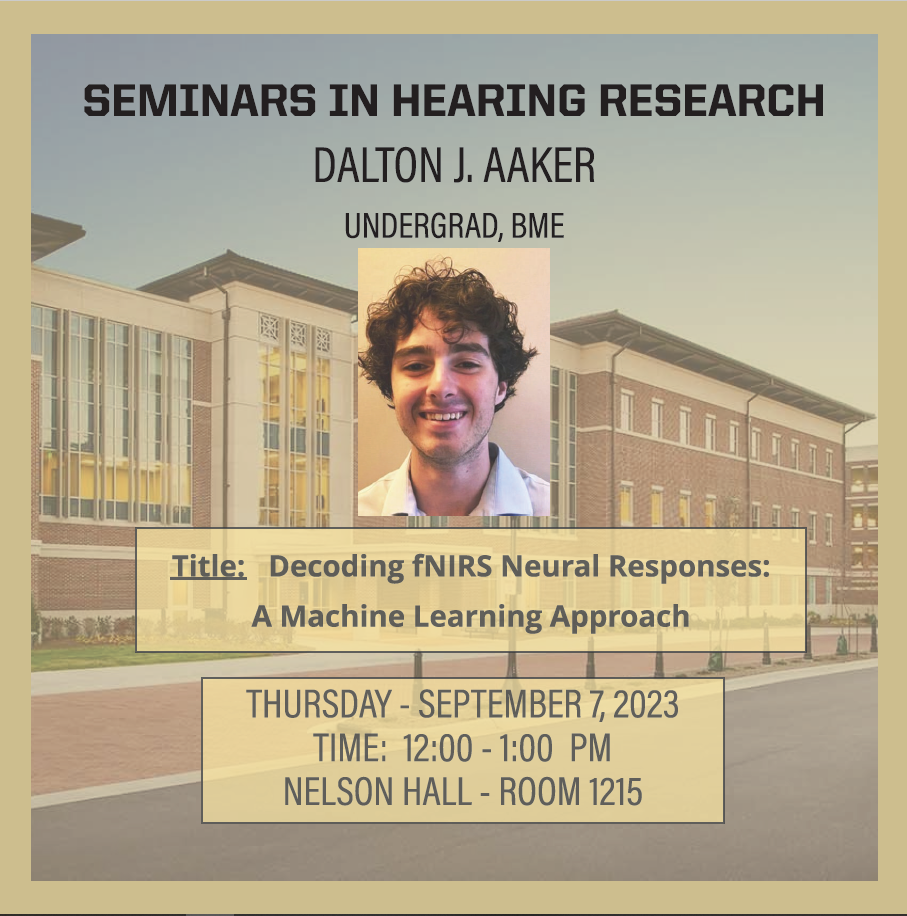
[cid:844384ce-32d1-4268-b1cc-61f8978e58ad] Seminars in Hearing Research Date: September 7, 2023 Place: Nelson Hall Room 1215 (located on University St right across from Lyles-Porter). Time: 12:00 - 1:00 pm Speaker: Dalton Aaker, undergraduate student, BME Title: Decoding fNIRS Neural Responses: A Machine Learning Approach Abstract: The aim of this project is to explore a machine learning model that accurately identifies positive auditory-evoked neural responses while controlling for factors that introduce noise to the neural signal and observe the effects of decoding these interferences. Human neuroimaging data collected via functional near-infrared spectroscopy (fNIRS) from a single subject twice daily for five consecutive days was analyzed. The data followed a block-design paradigm with two conditions: meaningful auditory speech and silence serving as a baseline control. Hemoglobin concentration data was collected using a continuous-wave fNIRS system (NIRx NIRSport2) with specific source-detector pairs optimized for brain regions associated with sound perception and language comprehension. Standard fNIRS data cleaning and preprocessing practices were applied, and Python's Sci-kit learn library was utilized for decoding and prediction on the extracted datasets. Estimators were trained on hemoglobin concentrations and applied stimuli, with cross-validation using Stratified K Folding. Some estimators required training on both systemic physiological and fNIRS datasets, using a feature union technique to join the relevant features. Preliminary analysis revealed that the model achieved the strongest predictive ability using only the oxygenated hemoglobin signal. At low subject counts, the best decoding accuracies were achieved using a combination of Galvanic Skin Response (GSR) and oxygenated hemoglobin signals. In general, physiological data did not consistently improve decoding accuracy, except for GSR data. This study provides insights applicable to machine learning, neuroscience, and optical engineering and the ability to combine cofactors for maximum prediction capabilities in machine learning models is a key area of ongoing research. This year's SHRP schedule is available here: https://purdue.edu/TPAN/hearing/shrp_schedule<https://nam04.safelinks.protection.outlook.com/?url=http%3A%2F%2Fogww.mj.am%2Flnk%2FAU8AAEukm7AAAchk2HAAALFJlZgAAYCsFQMAnDnUAATD7ABh_T90ybQipdUVQZ20y9CAzjYFPgAEkSo%2F5%2FVzPUtXKo0Dowllp_TK_BrQ%2FaHR0cHM6Ly9wdXJkdWUuZWR1L1RQQU4vaGVhcmluZy9zaHJwX3NjaGVkdWxl&data=05%7C01%7Cbnc-all%40ecn.purdue.edu%7Cc0b0c45e476e44cdfd4108dbaaeeb356%7C4130bd397c53419cb1e58758d6d63f21%7C0%7C0%7C638291714408743240%7CUnknown%7CTWFpbGZsb3d8eyJWIjoiMC4wLjAwMDAiLCJQIjoiV2luMzIiLCJBTiI6Ik1haWwiLCJXVCI6Mn0%3D%7C3000%7C%7C%7C&sdata=jwTTFP9YegwDxYJY49B5fOl6XHYifzzFH%2F%2BJx0zoVlM%3D&reserved=0> Titles and abstracts of all SHRP talks are here: https://purdue.edu/TPAN/hearing/shrp_abstracts<https://nam04.safelinks.protection.outlook.com/?url=http%3A%2F%2Fogww.mj.am%2Flnk%2FAU8AAEukm7AAAchk2HAAALFJlZgAAYCsFQMAnDnUAATD7ABh_T90ybQipdUVQZ20y9CAzjYFPgAEkSo%2F6%2Fa2vUEcd_J6SQbZdR8Ley5Q%2FaHR0cHM6Ly9wdXJkdWUuZWR1L1RQQU4vaGVhcmluZy9zaHJwX2Fic3RyYWN0cw&data=05%7C01%7Cbnc-all%40ecn.purdue.edu%7Cc0b0c45e476e44cdfd4108dbaaeeb356%7C4130bd397c53419cb1e58758d6d63f21%7C0%7C0%7C638291714408743240%7CUnknown%7CTWFpbGZsb3d8eyJWIjoiMC4wLjAwMDAiLCJQIjoiV2luMzIiLCJBTiI6Ik1haWwiLCJXVCI6Mn0%3D%7C3000%7C%7C%7C&sdata=EityH2CJiXTzj4qPcOuZjrXepJkIgwFsZi14Nem4mD4%3D&reserved=0> There will not be a hybrid option this year. Talks will either be held in-person only or via Zoom only for long-distance speakers. Christine Reidy Senior Administrative Assistant, Bindley Bioscience Center BIND, 1203 W. State Str., West Lafayette, IN 47907 [A close up of a logo Description automatically generated]<http://www.purdue.edu/>

participants (1)
-
 Abrol, Sangeeta Saddul