[Bmeroundtable-list] BME Monday Roundtable - Sept. 12

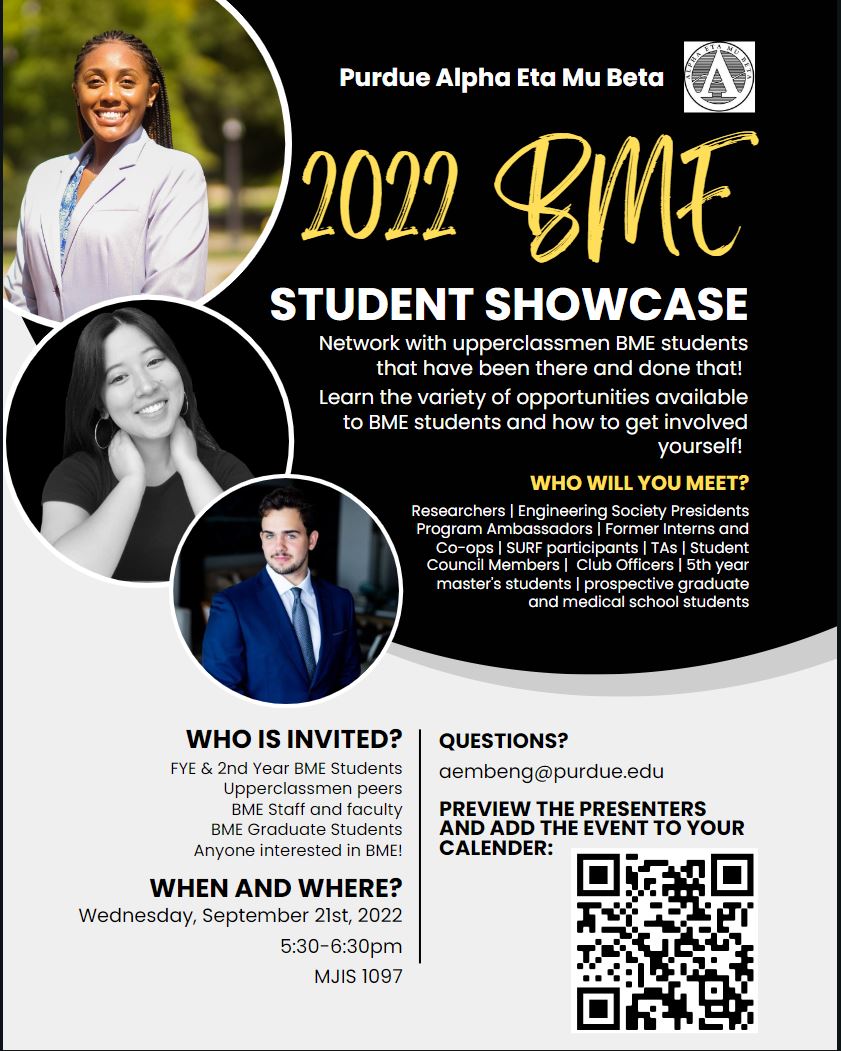
[cid:image003.jpg@01D8C692.DBF0B5E0] BME MONDAY ROUNDTABLE SEPTEMBER 12, 2022 HEADS NOTE Hello everyone to week of Sept. 12. Thank you for all the staff, student, faculty, and research associates for making the Friday afternoon Wodicka celebration and atrium dedication event. The energy in the room was palpable with many creative works on display and many distinguished guests including past, present, and future university presidents! A few items I want to bring attention to this week- please see the new call for collaborative proposals to initiate research projects with our colleagues at IUPUI to foster early engagement with our colleagues during the two year transitionary period covering the combination of our programs. Also, please see the flyer for the 2022 BME Student Showcase being put together by the Purdue Alpha Eta Mu Beta chapter. Everyone- have a great week! QUICK LINKS * Flu shots UPCOMING IMPORTANT DATES Week of September 12 Now - Wed., Oct. 26: Flu shots available to faculty and staff. All benefits-eligible employees and dependents covered on a Purdue health plan are eligible to receive the free flu vaccine. Regardless of location, individuals coming for a flu shot should bring their Purdue University ID (PUID) card or their Anthem medical plan ID card. Full schedule here: https://www.purdue.edu/hr/CHL/Services/FluShots/Faculty-staff-flushots.php Wed., Sept. 14: Weldon School of BME Seminar Series, 9:30 a.m., MJIS 1001 or via Zoom. Erpeng Dai, Postdoctoral Research Fellow, Radiological Sciences Laboratory, Stanford University will present "Probing Brain Microstructure with Diffusion MRI: Encoding, Acquisition, and Validation." Wed., Sept. 14: BME PhD Defense Announcement for Matthew J. Thompson (D. Umulis and V. Munnamalai, Co-Chairs), 11:30 a.m., MJIS 2001 and via Zoom. Wed., Sept. 14: Diabetes Research Virtual Seminar, 2:00 p.m. via Redcap. Jeffrey Pessin, Professor of Medicine and Director of Einstein-Mount Sinai Diabetes Research Center will present "Temporal and spatial cellular heterogeneity of hepatocyte metabolism." Thus., Sept. 15: Weldon Server Downtime! The BME file server weldon.ecn.purdue.edu will be down from 6:30 am to 7 am on Thursday, September 15, 2022 for system maintenance. Thurs., Sept. 15: BME PhD Defense Announcement for Jinxia Yao (Y. Tong, advisor), 2:30 p.m., MJIS 2001 and via Zoom. Upcoming important deadlines and info. Mon., Sept. 19: BME PhD Preliminary Exam Announcement for Conner C. Earl (C. Goergen, advisor), 3:00 p.m., MJIS 2001 and via Zoom. Wed., Sept. 21: The Purdue Chapter of Alpha Eta Mu Beta is proud to present the 2022 Undergraduate BME Student Showcase. Graduate students, faculty, and staff, come learn about the experiences and accomplishments of these great undergraduate students! When 5:30-6:30pm Where: MJIS 1097 Learn more here: https://aembpurdue.wixsite.com/aemb-purdue/team-4 Mon., Sept. 26: Grant Review Sounding Board Meeting, 1:00-3:00 p.m., MJIS 3041. RSVP to youngkim@purdue.edu Fri., Sept. 30: 7th Annual Purdue Institute for Drug Discovery Symposium, 9:00-4:30 p.m., Stewart Center Room 218A-D. Mon.-Tues., Oct. 10-11: Purdue Octoberbreak. No classes, but offices and buildings open normal hours. Tues., Oct. 11: MJIS Air Handling Shutdown beginning at 7:30 AM and lasting until approx. 3:00 PM for preventative maintenance of the building's air systems. This includes air ventilation supplies to all public, classroom and research areas, including chemical fume hoods. There should be NO chemicals used anywhere! All chemical fume hood activity should terminate by 5 PM Monday October 10th. You must make sure all chemical containers are sealed at that time. Chemical fume hoods will have notices posted - do not resume activity until BME staff have verified that work is complete, and have removed postings. Tues., Nov. 1: Proposals due for WL-Indy Collaborative Seed Grant. (From Jay Akridge): "We are happy to announce a collaborative seed grant competition, which is focused on establishing new research collaborations between faculty located at our two campuses. Please review the attached guidelines and reach out to colleagues to start building new research collaborations. Proposals are due November 1, 2022. See attached RFP. Wed., Nov. 9 - Sat., Nov. 12: The Annual Biomedical Research Conference for Minoritized Scientists (ABRCMS) is a go-to conference for underrepresented groups in STEM fields. Scientific or professional development session submissions due July 29. PROTECT PURDUE * Fall 2022 update: Protect Purdue Fall expectations https://protect.purdue.edu/updates/fall-2022-what-you-need-to-know/ Committee Updates Graduate Admissions Update 1. Purdue Engineering Virtual Graduate Showcase <https://engineering.purdue.edu/Engr/Academics/Graduate/graduate-showcase> - September 25 - 26, 2022. 2. Graduate Diversity Visitation Program (GDVP)<https://www.purdue.edu/gradschool/diversity/programs/graduate-diversity-visitation-program/>-October 23rd-26th · Will typically host students on Monday, October 24th from 1-2 pm and will need grad students and faculty to meet with them. 3. New Application Deadline Reminder: December 1st Resources, attachments, further information Weldon School of BME Seminar Series, Wed., Sept. 14, 9:30 a.m., MJIS 1001 or via Zoom. Erpeng Dai, Postdoctoral Research Fellow, Radiological Sciences Laboratory, Stanford University will present "Probing Brain Microstructure with Diffusion MRI: Encoding, Acquisition, and Validation." Abstract: Diffusion MRI is an important imaging tool to non-invasively detect the intra- and extra-cellular motion status of water molecules, and thus reveal the microstructural information of the human brain. However, the current acquisition and encoding techniques of diffusion MRI remain inadequate for accurate brain microstructure mapping. For example, the widely used diffusion MRI acquisition method, single-shot echo planar imaging (ss-EPI), is known to be confronted by a typically low resolution, relatively low SNR, and geometric distortions. Diffusion tensor imaging (DTI) with single/linear diffusion encoding is a commonly used diffusion encoding pattern but lacks sensitivity and specificity for brain microstructure detection. In this presentation, I will first review the basic principles of diffusion MRI. Then I will introduce our recent work on the developments of new diffusion encoding and acquisition techniques and how they affect the measurement of brain microstructures. Finally, I will introduce other work in Dr. Jennifer McNab's lab for diffusion validation and interpretation, including histology, animal, and patient studies. Bio: Dr. Erpeng Dai is currently a postdoctoral research fellow in the Radiological Sciences Laboratory (RSL) at Stanford University, working with Dr. Jennifer McNab. He received his Ph.D. from Biomedical Engineering, Tsinghua University, Beijing, China in 2018. Since his Ph.D. study, Dr. Dai has focused on the development and employment of advanced diffusion acquisition and encoding models for a better understanding of the human brain microstructures. Specifically, Dr. Dai has developed a series of new acquisition techniques for high-resolution and fast diffusion MRI. Recently, Dr. Dai's research interests further extend to the design and use of new diffusion encoding waveforms to improve the sensitivity and specificity of human brain microstructure mapping. Dr. Dai is keen on leveraging the up-to-date hardware advancement, such as the ultra-high field (7T) and high-performance gradient system, to push the limits of diffusion MRI. He is also actively interacting with a multi-discipline team (radiology, psychology, neurology, and neurosurgery) to apply the advanced diffusion MRI for addressing neuroscientific and clinical problems. ~BME Faculty Host: Dr. Uzay Emir ~ NOTE: Students registered for the seminar are expected to attend in-person. Zoom link: https://purdue-edu.zoom.us/j/7731446991?pwd=RHdkZTVnRkxTM3J3dnRvY1VLWTlYUT09 BME PhD Defense Announcement for Matthew J. Thompson (D. Umulis and V. Munnamalai, Co-Chairs), Wed., Sept. 14, 11:30 a.m., MJIS 2001 and via Zoom. Everyone is invited to attend the public presentation beginning at 11:30am EST. Title: Precision of Positional Information Along the Developing Cochlea Radial Axis: Linear BMP Activity Helps Set the Stage Committee: David M. Umulis, Co-Chair; Vidhya Munnamalai, Co-Chair; Srividya Iyer-Biswas; Michael G. Heinz; Tamara L. Kinzer-Ursem Abstract: Positional information encoded in signaling molecules is essential for early patterning in the prosensory domain of the developing cochlea. The cochlea contains an exquisite repeating pattern of sensory hair cells and supporting cells, and this requires precision in the morphogen signals that set the initial radial compartment boundaries, but this has not been investigated. To measure gradient formation and morphogenetic precision in developing cochlea, we developed a quantitative image analysis procedure measuring SOX2 and pSMAD1/5/9 profiles in mouse embryos at E12.5, E13.5, and E14.5. Intriguingly, we found that pSMAD1/5/9 profile forms a linear gradient in the medial ~75% of the PSD during embryonic day (E)12.5 and E13.5. This is a surprising readout of activity for a diffusive BMP4 ligand secreted from a tightly constrained lateral region, since morphogens typically form exponential or power-law gradient shapes. This is meaningful for gradient interpretation because while linear profiles offer the theoretically highest information content and distributed precision for patterning, a linear morphogen gradient has not yet been observed. In addition to the information-optimized linear profile, we found that while pSMAD1/5/9 is stable during this timeframe an accompanying gradient of SOX2 shifts dynamically. Third, we see through joint decoding maps of pSMAD1/5/9 and SOX2 that there is a high-fidelity mapping between signaling activity and position in the regions soon to become Kölliker's organ and the organ of Corti where radial patterns are more intricate. Mapping is ambiguous in the prosensory domain precursory to the outer sulcus, where cell fates are uniform. Altogether, this research provides new insights into the precision of early morphogenetic patterning cues in the radial cochlea prosensory domain. Join Zoom Meeting: https://purdue-edu.zoom.us/j/94518363803?pwd=QjQvd0x6ank0NjViODI3WW50UGRPUT0... (Meeting ID: 945 1836 3803, Passcode: 722960) Diabetes Research Virtual Seminar, Wed., Sept. 14, 2:00 p.m. via Redcap. Jeffrey Pessin, Professor of Medicine and Director of Einstein-Mount Sinai Diabetes Research Center will present "Temporal and spatial cellular heterogeneity of hepatocyte metabolism." Register here: https://redcap.link/DRC-JeffreyPessin09.14.22 Abstract: The hepatic regulation of glucose and lipid metabolism occur in a zonation selective manner with hepatocytes in the periportal region displaying greater extents of gluconeogenesis and hepatocytes in the pericentral region displaying greater extents of de novo lipogenesis. Using single cell RNAseq coupled with single molecule fluorescence in situ hydridization, we will present data demonstrating that the zonation specificity of gluconeogenic gene expression is not fixed but can vary depending on physiologic conditions. More detailed transcriptional analyses further reveals that the transcriptional activation mechanism of gluconeogenic and lipogenic gene expression are distinct. The consequences of these findings with regard to metabolic dysregulation during insulin resistance will be discussed. The Diabetes Research Virtual Seminar Series is sponsored by the Diabetes Research Centers and Centers for Diabetes Translational Research whose logos are shown below. Questions, feedback, or suggestions for future speakers? Contact us at: virtual.seminar.series@vumc.org More information can be found here: https://www.vumc.org/diabetescenter/virtual-seminar-series BME PhD Defense Announcement for Jinxia Yao (Y. Tong, advisor), Thurs., Sept. 15, 2:30 p.m., MJIS 2001 and via Zoom. Everyone is invited to attend the public presentation beginning at 2:30pm. Title: An investigation of fMRI-based perfusion biomarkers in resting state and physiological stimuli Advisory committee: Dr. Yunjie Tong (Chair), Dr. Vitaliy Rayz, Dr. Ulrike Dydak, Dr. Jean Chen Zoom link: https://purdue-edu.zoom.us/j/94745595165?pwd=NXhHekhKbXJJMzJGUTBvQ0Y4ZVpnUT0... (Meeting ID: 947 4559 5165, Passcode: 411944) Abstract: Cerebrovascular disease is the most common life-threatening neurological disease in the United States. For example, stroke is the third leading cause of death in the U.S. To support normal brain function, maintaining adequate brain perfusion (i.e., cerebral blood flow (CBF)) is important. Therefore, it is crucial to assess the brain perfusion so that early intervention can be applied if abnormal perfusion is observed. The goal of my study is to develop metrics to measure the brain perfusion by understand the brain physiology using blood-oxygen-level-dependent (BOLD) functional MRI (fMRI) under resting state and physiological stimulus. My first and second studies focused on deriving the blood arrival time using the BOLD under resting state. In the first study, we extracted the systemic low-frequency oscillations (sLFOs) fMRI signals from the internal carotid arteries (ICA) and the superior sagittal sinus (SSS). Consistent and robust results of the ICA signals leading the SSS signals by about 5 seconds among 400 fMRI scans. This delay time could be considered as an effective perfusion biomarker that associates with the cerebral circulation time (CCT). To further explore sLFO in assessing dynamic blood flow changes during the scan, in my second study, a "carpet plot", a 2-dimensional plot (time vs. voxel) of scaled fMRI signal intensity, was reconstructed and paired with a developed slope-detection algorithm. Tilted vertical edges across which a sudden signal intensity change was observed. The edges were successfully detected by the algorithm and the averaged propagation time derived from the carpet plot matches the cerebral circulation time. Given that CO2 is a vasodilator, controlling of inhaled CO2 is able to modulate the BOLD signal, therefore, as a follow-up study, we focused on investigating the feasibility of using the CO2 modulated sLFO signal as a "natural" bolus to track the CBF with the tool developed from the second study. Meaningful and comparable transit times were derived from the CO2-MRI carpet plots. Not only the timing, the BOLD signal deformation (the waveform change) under CO2 challenge is also a very useful perfusion information, which represents how the brain react to stimulus. Therefore, my fourth study focused on characterizing the brain reaction to the CO2 stimulus to better measure the brain health. Overall, these studies deepen our understanding of fMRI signal and the derived perfusion parameters can potentially be used to assess some cerebrovascular diseases, such as stroke, ischemic brain damage, and steno-occlusive arterial disease in addition to functional activations. BME PhD Preliminary Exam Announcement for Conner C. Earl (C. Goergen, advisor), Mon., Sept. 19, 3:00 p.m., MJIS 2001 and via Zoom. Everyone is invited to the public presentation from 3:00-4:00 pm. Title: Simplified, Improved, and Automated 4D Cardiac Image Analysis Advisory committee: Craig J. Goergen, Chair; Guang Lin; Vitaliy L. Rayz; Larry W. Markham; Jonathan H. Soslow Abstract: Cardiovascular disease is the leading cause of death worldwide. Cardiac imaging is an increasingly utilized tool to help with early identification and treatment of disease, however as imaging techniques advance in complexity and application, there is a greater need for accessibility and feasibility for clinical and research use. For example, 3D and 4D imaging methods arguably provide a greater morphological and quantitative assessment of cardiac fitness, however these methods also introduce complexity to analysis and interpretation of results. Deep learning for biomedical image segmentation and classification is a promising method that could potentially be used to automate analysis and reduce complexity but requires an informed approach to do so. This proposal builds on previously developed strengths in our lab in using 4D ultrasound to evaluate mouse models of cardiac disease and 4D cardiac magnetic resonance imaging in the characterization of Duchenne muscular dystrophy-associated cardiomyopathy. Using these frameworks, we plan to simplify, improve, and automate 4D cardiac image analysis in both experimental and clinical cardiac image datasets. We hypothesize that these improvements will decrease analysis time of 4D image datasets by more than 90% and that automated image analysis will achieve >95% accuracy for both image segmentation and classification. Achieving these goals will address a growing need in cardiac imaging to provide accessible techniques and technologies to researchers and healthcare providers with the goal of improving cardiac outcomes for patients worldwide. Zoom link: https://purdue-edu.zoom.us/j/91304131947 Grant Review Sounding Board Meeting, Mon., Sept. 26, 1:00-3:00 p.m., MJIS 3041. RSVP to youngkim@purdue.edu<mailto:youngkim@purdue.edu> This is a friendly reminder that our next sounding board for feedback and review of grant ideas will meet on Wednesday, September 26th, 1:00-3:00 pm in MJIS 3041. The NIH submission cycle for R01s is October 5 and November 5 for new and resubmissions. These sessions have been helpful by providing a round of feedback from your peers. Even if you are not submitting this cycle, please join if you are able, to learn about what your colleagues are working on and to provide feedback. Please RSVP to youngkim@purdue.edu<mailto:youngkim@purdue.edu>, so we can send you the aims pages for review prior to the start of the meeting. Even if you did not sign up, you are still welcome to attend and get feedback and provide feedback! Please email us your one page aims/objectives the night before so that we could share it with the other members of the research group who will be in attendance. During the meeting, plan to have ~ 3 slides describing: 1. the specific call/agency (you can just cut and paste the RFA onto the slide) 2. your objectives/hypothesis and tasks/aims (concise bullet points) 3. what challenges you are facing and want direct feedback on (also concise bullet points) Also, if this is a resubmission, prepare your response to previous reviews prepared if possible. If you have questions or thoughts, please email youngkim@purdue.edu<mailto:youngkim@purdue.edu> 7th Annual Purdue Institute for Drug Discovery Symposium, Friday, September 30, 9:00 a.m. - 4:30 p.m., Stewart Center Room 218A-D. Keynote speakers include Joseph Schlessinger, Yale University (Cell Signaling by Receptor Tyrosine Kinases; from Basic Principles to Cancer and other Therapies), Gunda Georg, University of Minnesota (Retinoic Acide Receptor Antagonist for Non-hormonal Male Contraception), and Philip Low, Purdue University (A New Generation of Targeted Therapies). Register here: https://purdue.ca1.qualtrics.com/jfe/form/SV_aWQOjeKOgSMQLnU BMES 2022 Annual Meeting will be held in San Antonio, Texas on October 12-15, 2022. Registration is now open! Register here: https://s7.goeshow.com/bes/annual/2022/attendee_reg.cfm Attachments BME Seminar Schedule Fall 2022 PIDD Symposium Sessions Student Showcase Flyer WL-Indy Collaboration -- Bmeroundtable-list mailing list Bmeroundtable-list@ecn.purdue.edu https://engineering.purdue.edu/ECN/mailman/listinfo/bmeroundtable-list
participants (1)
-
 Gelfand, Johanna K